The Challenger 300 is still the backbone of the super-midsize segment. It built its reputation on range, cabin comfort, and dispatch reliability, and it holds its buyer base across corporate flight departments, charter operators, and private owners. The production run ended years ago, so the fleet is fixed, and that makes supply and demand easier to read on this airframe than on most. Here is where it stands entering September.
The squeeze that started in July kept going. Inventory has come down for a second straight month while sales held their pace, and the Challenger 300 enters September thinner than it has been all year. Twenty-eight aircraft have sold in the past six months against 16 available today. Buyers are working with fewer options every month.
Fleet Size and Availability
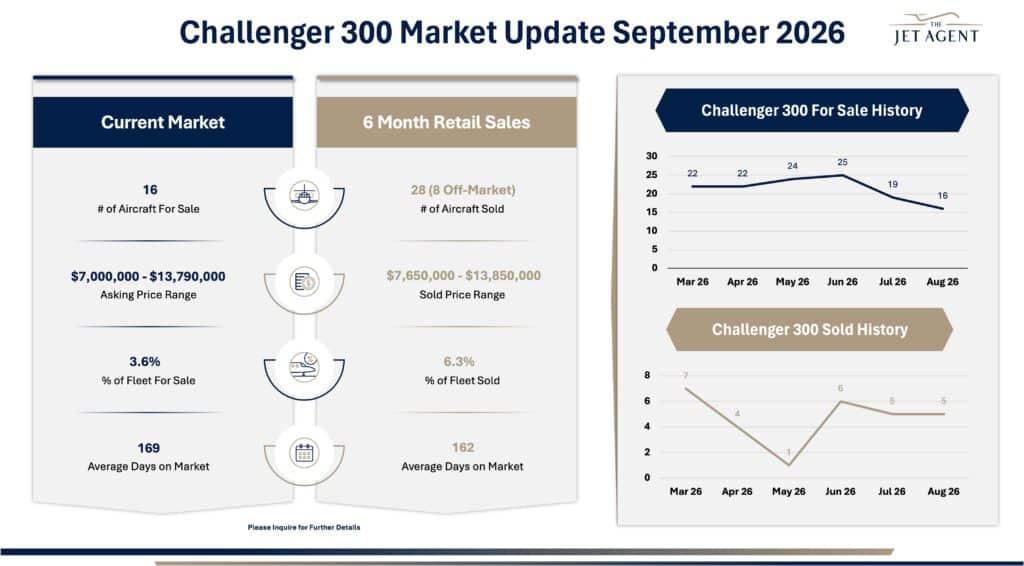
There are 16 Challenger 300s for sale, or 3.6% of the fleet.
Availability sat flat through the spring, holding at 22 aircraft in March and April before drifting up to 24 in May and peaking at 25 in June. Then it fell off. Nineteen in July, 16 in August. That is nine airplanes off the market in two months, a 36% cut from the June peak.
At 3.6%, the shelf is close to bare. Put that next to the 6.3% of the fleet that traded in the past six months and the picture is simple: nearly twice as many Challenger 300s changed hands as are currently on offer.
Market Listings
Asking prices run $7.0 million to $13.79 million. Six-month sold prices ran $7.65 million to $13.85 million.
Those two ranges sit almost on top of each other, which tells you sellers are asking what the market has actually been paying. That is not always true in this segment. Where an individual airplane lands inside the spread still comes down to model year, total time, maintenance status, program enrollment, and condition, and those factors move the number by millions, not thousands.
Current listings average 169 days on market. Aircraft sold over the past six months averaged 162 days. A seven day gap is nothing. What is available today is about as marketable as what already sold, so nobody should be reading the current inventory as leftovers.
Sales Activity
Twenty-eight Challenger 300s have sold in the past six months, eight of them off market.
The monthly pace was choppy early. Seven in March, four in April, then a single transaction in May. June came back with six, and July and August each closed five.
The three month run matters more than any single month. Sixteen sales since June, while advertised inventory fell from 25 to 16 over the same stretch. Volume held and supply drained at the same time.
Key Takeaways
• 16 aircraft available, 3.6% of the fleet.
• 28 aircraft sold in six months, 6.3% of the fleet.
• Eight of those 28 were off market, close to a third of the activity never hit an advertisement.
• Inventory fell from 25 in June to 16 in August.
• 16 sales in the past three months, five in each of July and August.
• Current and sold days on market are nearly identical at 169 and 162.
Key Insight
Two months of falling inventory against steady volume is the cleanest seller signal this market gives. There is no oversupply building, no stale inventory sitting, and no sign that demand cooled over the summer. If you own one and have been waiting for the right window, this is it. If you are buying, understand that a third of recent deals never showed up on a listing site, so shopping the advertised fleet means shopping a fraction of the market. Get in front of the airplanes before they are advertised, or accept that you are choosing from 16 and everyone else is looking at the same 16.