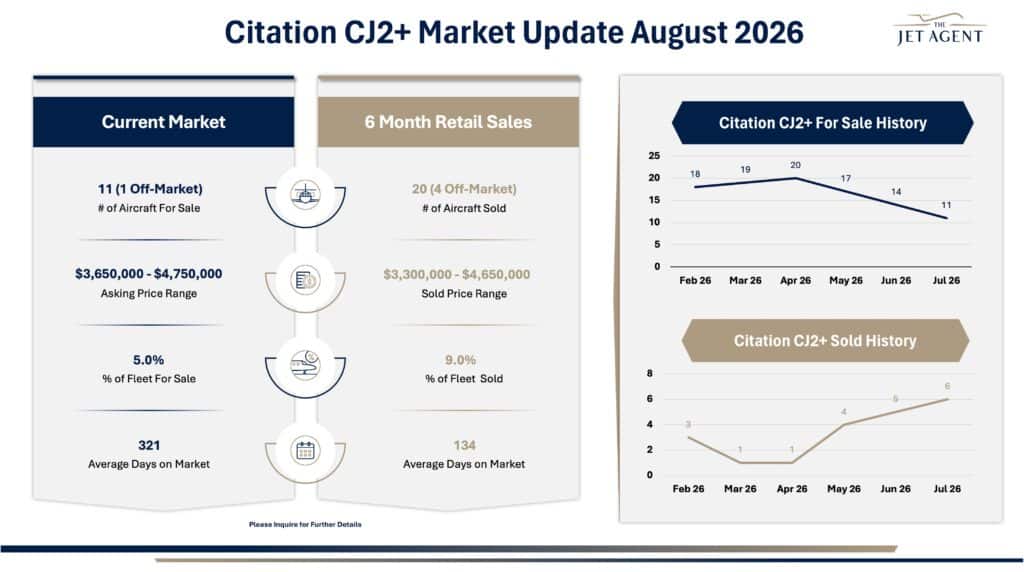
The Citation CJ2+ market enters August with one of the clearest tightening trends among the Citation models we track. Available inventory has fallen sharply at the same time transaction activity has accelerated, creating a stronger supply-and-demand environment than we have seen in recent months. With 20 aircraft sold over the past six months compared with just 11 currently available, buyers are actively absorbing CJ2+ inventory and the pace of that absorption has increased meaningfully as summer has progressed.
Fleet Size and Availability
There are currently 11 Citation CJ2+ aircraft identified as available for sale, including 1 off-market aircraft, representing just 5.0% of the worldwide fleet.
The inventory trend is particularly significant. Supply reached a six-month high of 20 aircraft in April before declining to 17 in May, 14 in June, and just 11 in July—a 45% reduction in available inventory in only three months. Unlike a market where inventory contracts simply because fewer owners are listing aircraft, this decline has occurred while transaction activity has been accelerating.
That combination is important. Buyers are not merely facing fewer new listings; they are actively removing aircraft from the available pool. If that pace continues into late summer and early fall, selection (particularly among the strongest aircraft) could tighten further.
Market Listings
Current asking prices range from $3.65 million to $4.75 million, while reported transaction prices over the past six months range from $3.3 million to $4.65 million.
Current listings average 321 days on market, compared with just 134 days for aircraft sold during the past six months. That 187-day difference is one of the most revealing statistics in the CJ2+ market.
It demonstrates that tightening inventory does not mean every available CJ2+ is equally desirable or that scarcity alone will cause an aircraft to sell. Buyers continue to distinguish sharply between aircraft based on price, maintenance status, engine program enrollment, remaining engine time, equipment, condition, and overall presentation.
In other words, the CJ2+ market is increasingly short of desirable, properly positioned inventory, not simply short of aircraft.
Sales Activity
A total of 20 CJ2+ aircraft have sold during the past six months, including 4 off-market transactions, representing 9.0% of the worldwide fleet.
The direction of monthly sales activity is particularly compelling. After only one transaction in March and one in April, sales increased to 4 in May, 5 in June, and 6 in July. July therefore produced the strongest sales month of the entire six-month period.
That progression (4, then 5, then 6 monthly sales) occurred simultaneously with inventory falling from 20 aircraft in April to just 11 in July. Few market indicators provide a clearer picture of strengthening absorption.
Key Takeaways
• 11 CJ2+ aircraft are currently available, including 1 off-market, representing just 5.0% of the fleet.
• Inventory has declined 45% from its April high, falling from 20 aircraft to 11 in only three months.
• 20 aircraft sold during the past six months, representing 9.0% of the fleet.
• Monthly transactions accelerated from 4 in May to 5 in June and 6 in July.
• July recorded the strongest sales month of the six-month period.
• Current asking prices range from $3.65 million to $4.75 million.
• Current listings average 321 DOM, compared with only 134 days for sold aircraft.
• The large DOM gap indicates that buyers remain highly selective despite tightening supply.
Key Insight
The CJ2+ is showing one of the strongest classic supply-and-demand signals in the Citation market this month: inventory is contracting rapidly while transaction activity is accelerating. Available supply has declined 45% since April, while monthly sales climbed from one transaction in April to six in July.
But the 187-day gap between the average days on market for current listings and recently sold aircraft adds an important layer to the story. Buyers are absorbing well-positioned aircraft quickly while allowing less compelling inventory to remain on the market. Tight supply therefore should not be interpreted as automatic leverage for every seller.
For buyers, the risk heading toward Q4 is that the best CJ2+s (those with favorable maintenance status, strong engine coverage, desirable equipment, good cosmetics, and realistic pricing) may become increasingly difficult to find. For sellers with aircraft that meet those criteria, current conditions are becoming increasingly favorable. For aircraft that do not, the market is still demonstrating very clearly that scarcity alone is not enough.