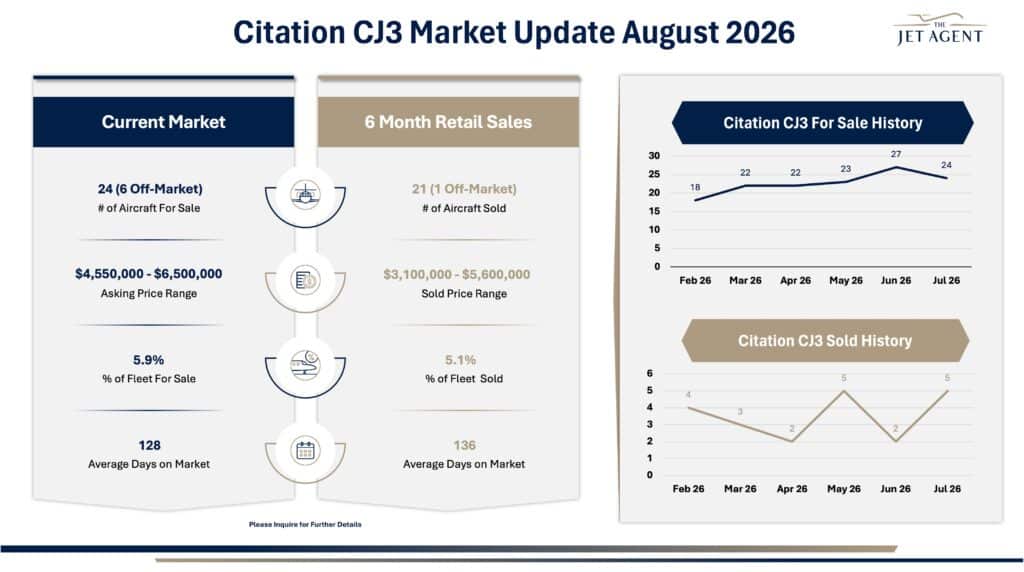
The Citation CJ3 market enters August as one of the healthiest and most orderly Citation markets we are tracking. Transaction activity remains strong, inventory has pulled back from its June high, and the relationship between current and sold-aircraft days on market is remarkably consistent. With 24 aircraft currently available and 21 sales over the past six months, the CJ3 is neither meaningfully oversupplied nor unusually constrained, giving both buyers and sellers a relatively balanced environment.
Fleet Size and Availability
There are currently 24 Citation CJ3 aircraft available for sale, including 6 off-market aircraft, representing 5.9% of the worldwide fleet.
Inventory gradually increased through the spring, moving from 18 aircraft in February to 22 in March and April, 23 in May, and a six-month high of 27 in June. July reversed that trend, with inventory declining to 24 aircraft.
That decline is encouraging because it occurred during one of the strongest sales months of the period. Rather than inventory simply falling because fewer aircraft entered the market, July’s reduction coincided with five completed transactions, suggesting healthy absorption.
At just under 6% of the fleet currently available, buyers still have meaningful selection, but supply is not high enough to suggest an oversupplied market.
Market Listings
Current asking prices range from $4.55 million to $6.5 million, with available aircraft averaging 128 days on market.
As with most established Citation models, individual CJ3 values can vary meaningfully based on model year, total time, maintenance status, engine program enrollment, cosmetics, equipment, and overall aircraft condition.
The most notable market statistic is the relationship between active and sold-aircraft days on market. Current inventory averages 128 DOM, compared with 136 days for aircraft sold during the past six months.
That eight-day difference is unusually small and suggests today’s active inventory is generally positioned in line with aircraft that have actually transacted. Unlike markets where stale inventory is accumulating, the CJ3 currently shows little evidence of a meaningful disconnect between sellers’ expectations and buyer behavior.
Sales Activity
A total of 21 CJ3 aircraft have sold during the past six months, including 1 off-market transaction, representing 5.1% of the fleet. Reported transaction prices ranged from $3.1 million to $5.6 million.
Monthly sales have remained healthy, although somewhat uneven: four transactions in February, three in March, two in April, five in May, two in June, and five in July. July therefore tied May for the strongest sales month of the six-month period.
The combination of five July sales and a decline in inventory from 27 to 24 aircraft is a positive signal heading into late summer.
Key Takeaways
• 24 CJ3 aircraft are currently available, including 6 off-market.
• Current inventory represents 5.9% of the worldwide fleet.
• Inventory declined from a six-month high of 27 aircraft in June to 24 in July.
• 21 aircraft sold during the past six months, representing 5.1% of the fleet.
• July recorded 5 sales, tied with May for the strongest month of the period.
• Asking prices range from $4.55 million to $6.5 million.
• Current listings average 128 DOM, compared with 136 days for sold aircraft.
• The near-identical DOM figures suggest active inventory is generally aligned with recent market-clearing conditions.
Key Insight
The CJ3 currently stands out as one of the most balanced and liquid Citation markets. Inventory remains sufficient to give buyers meaningful choice, yet supply is not excessive, and July demonstrated strong absorption with five transactions and a simultaneous reduction in available inventory.
Perhaps even more important is the close relationship between current and sold-aircraft days on market. At 128 days versus 136 days, today’s inventory is behaving very similarly to aircraft that have recently reached the closing table. That suggests neither buyers nor sellers currently have outsized leverage and that pricing expectations are, on average, relatively well aligned.
For buyers, the CJ3 market offers something increasingly valuable: choice without obvious oversupply. There are enough aircraft available to compare specifications, maintenance status, condition, and value, but desirable aircraft are still transacting at a healthy pace.
For sellers, the market remains receptive to properly positioned aircraft. Unlike more supply-heavy Citation segments, there is little indication that sellers need to discount simply to overcome excess inventory. Strong aircraft that enter the market at realistic prices should continue to attract buyer attention, particularly if the recent pace of activity carries into the fall.